Jean Harris, 'Scarsdale Diet' doctor killer, dies
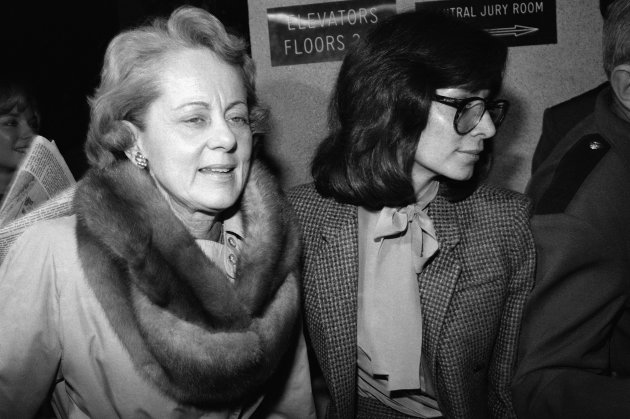
NEW HAVEN, Conn. (AP) — Jean Harris, the patrician girls' school headmistress who spent 12 years in prison for the 1980 killing of her longtime lover, "Scarsdale Diet" doctor Herman Tarnower, in a case that rallied feminists and inspired television movies, has died. She was 89.
Harris died Sunday at an assisted-living facility in New Haven, her son, James Harris, said Friday.
She had claimed the shooting of Tarnower, 69, was an accident. Convicted of murder in 1981, Harris suffered two heart attacks while serving her sentence in the Bedford Hills women's prison north of New York City. She was granted clemency by then-Gov. Mario Cuomo when she underwent heart bypass surgery in December 1992 and was released on parole three weeks later.
She later founded Children of Bedford Inc., a nonprofit organization to provide scholarships and tutoring for children of female prison inmates.
Her trial for shooting Tarnower, the millionaire cardiologist famous for devising the Scarsdale Diet — a weight-loss book and sensation of the 1970s named for the New York suburb where he practiced — brought feminists rallying to her defense.
They pictured her as a woman victimized by a male-dominated society, adrift because she was getting older and her lover of 14 years was brushing her off in favor of his younger office assistant. In addition, they said, she was in the thrall of antidepressant drugs Tarnower had prescribed for her.
The case inspired two made-for-television movies, "The People vs. Jean Harris," which aired not long after her 1981 conviction, and "Mrs. Harris," which ran on HBO in 2006.
Harris always maintained that she went armed to Tarnower's Westchester County estate in Purchase on March 10, 1980, to confront him over his womanizing and kill herself, but unintentionally shot him four times in a struggle over the gun. She later acknowledged at a parole hearing that she was "certainly guilty of something. I caused the man's death."
A jury convicted her of murder, and she was sentenced to 15 years to life.
Her lawyer had unsuccessfully gambled on an all-or-nothing strategy that eschewed an "extreme emotional disturbance" defense and did not allow the jury to consider a lesser charge such as manslaughter.
Jurors said afterward it was Harris's own testimony that led them to convict her.
They said they tried to re-enact her account of the struggle for the gun and did not find it credible.
The defense maintained that jealousy was not a factor. But during cross-examination, the prosecutor introduced a letter written just prior to the shooting in which Harris referred to her rival as an "ignorant slut" and "a vicious, adulterous psychotic."
"The fact was, Jean Harris was too much of a lady to admit that she was jealous of the office girl," the late author Shana Alexander wrote in her book about the case, "Very Much a Lady." ''She would rather go to prison than acknowledge it. And she did."
As an inmate, Harris criticized authority, chafing under what she saw as arbitrary, counterproductive rules. In books and articles she wrote and in interviews, she advocated reform, both for her own benefit and that of other imprisoned women.
Housed in the prison's honor wing, she taught mothering skills to expectant inmates and worked in the Bedford Hills children's center.
Born Jean Streuven on April 27, 1923, she grew up in the Cleveland suburb of Shaker Heights, attended private schools, graduated magna cum laude from Smith College and married industrialist James Harris.
The couple lived in Grosse Pointe, Mich., and had two sons. Harris also got her first job there, teaching first grade.
She and James Harris divorced in 1966. A few months later, the slender, blond, blue-eyed divorcee of 43 met Tarnower, 12 years her senior, at a party on Park Avenue in New York. They talked about marriage early in the relationship, but that never panned out, and Harris remained his lover.
In 1977, she left a sales administration job in New York to become headmistress of the Madeira School for girls in the Washington suburb of McLean, Va., a position that also got her listed in the capital's social register.
Weekends and vacations were spent with Tarnower, traveling or on his arm at social gatherings.
She also earned a mention in the acknowledgments in his best-selling diet book, "The Complete Scarsdale Medical Diet," for helping with research.
But Tarnower's dalliances with other, younger women drove Harris to desperation, and, according to her account, she decided to drive from Virginia to his home and kill herself in his presence.
She testified at her trial: "In Westchester, I always felt I was a woman in a pretty dress that went to dinner parties with Dr. Tarnower. In Washington, I was a woman in a pretty dress and a headmistress. I wasn't sure who I was, and it didn't seem to matter."
The expensively dressed Harris came across as snobbish, arrogant and jealous of the younger woman who had replaced her as the principal object of Tarnower's attention.
During the trial, it was assumed that Harris insisted on testifying about the fateful last meeting in Tarnower's bedroom. She later said she would not have taken the stand had her lawyer told her to "keep quiet."